Skip to content
BPM KEY FINDER · BATCH · NO UPLOAD

Free BPM and Key Finder

Drop in one song or a whole set to get the key and BPM of every track, with Camelot codes for mixing. No upload.

or drop one song or a whole batch here

MP3, WAV, M4A, OGG, FLAC or any format your browser can decode; up to the first 10 minutes · Maximum 100 MBUp to 50 files per batch, analyzed one after another on your device

Harmonic mixing helper

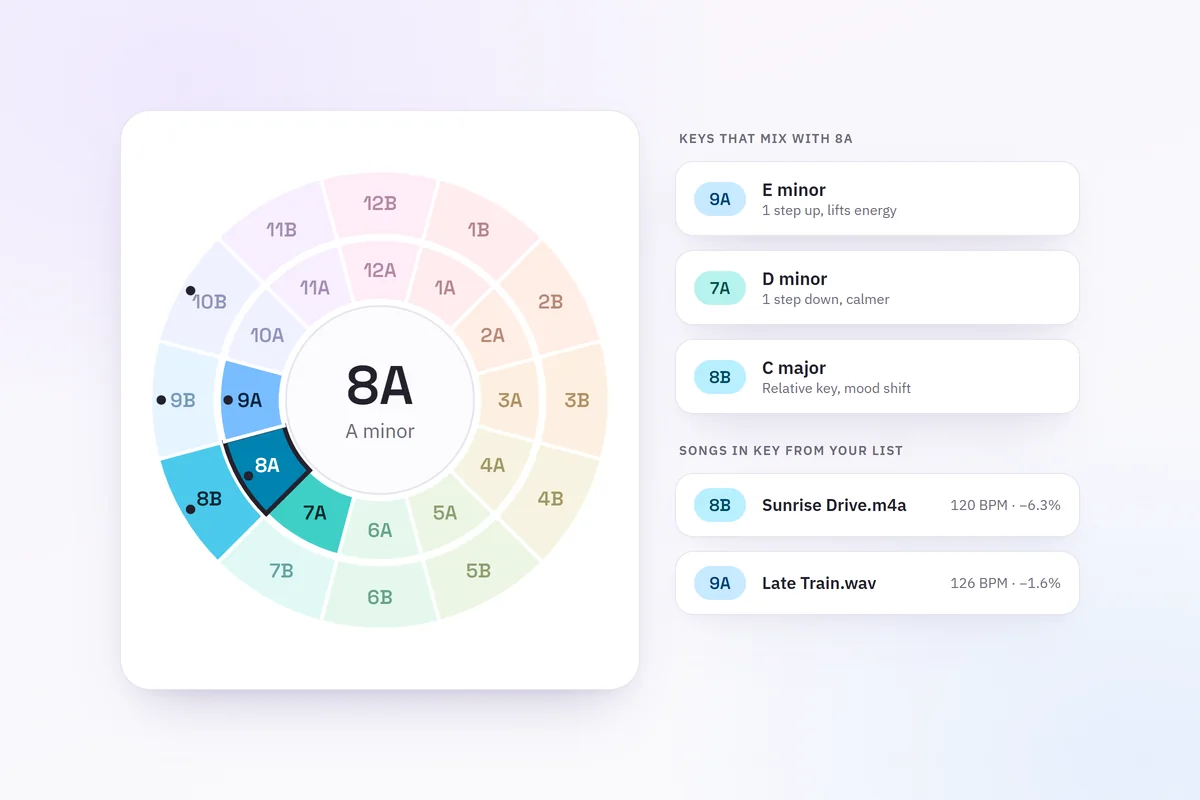
Analyze a track, or pick any key on the Camelot wheel, to see which keys mix with it.

  • Outer ring, letter B: major keys
  • Inner ring, letter A: minor keys
  • Neighbors and the same slice mix cleanly
  • A dot marks a key found in your list

Tap tempo

Tap the button (or press Space) along with the beat; four or more taps give a BPM.

0 taps

Your file is processed in your browser and never uploaded

01

Drop in one or many songs

Choose files or drag up to 50 tracks onto the box above.

02

Find key and BPM locally

Files are analyzed in turn on your device, not uploaded.

03

Sort, mix and export

Sort by Camelot or BPM, check matches, then save a CSV.

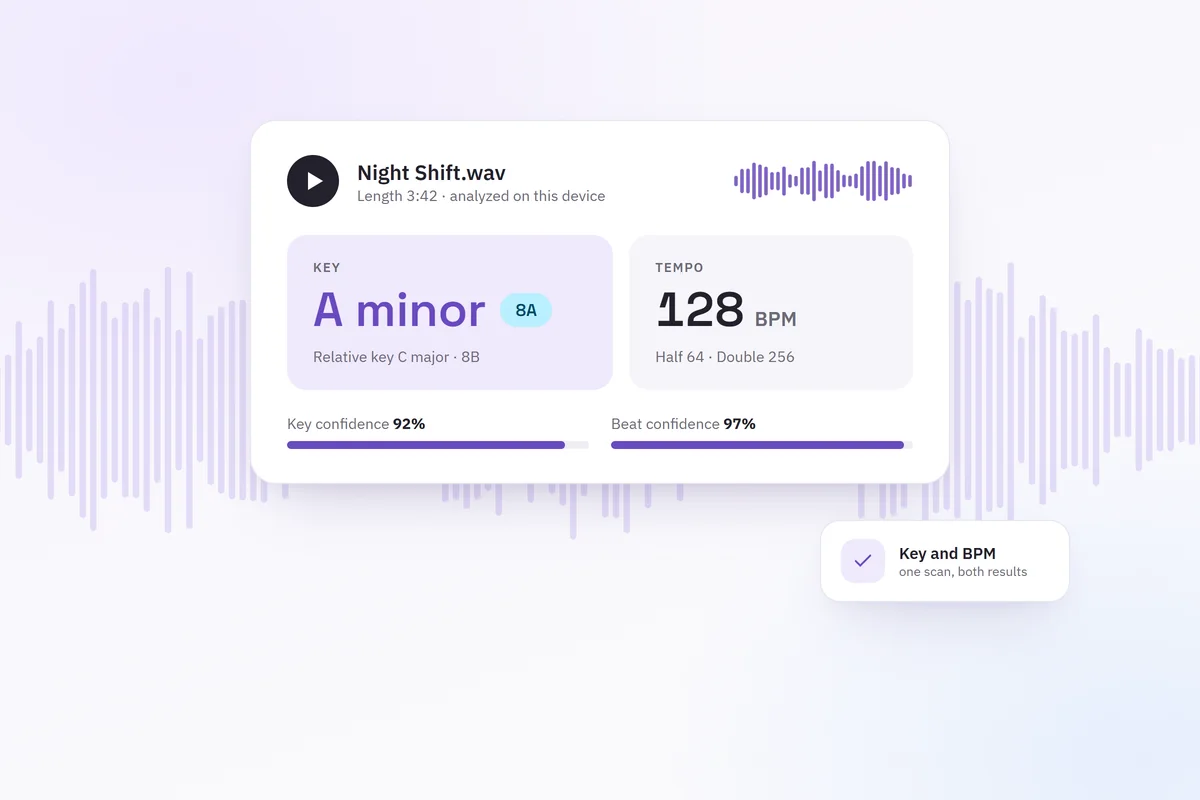
BPM and key finder result for one song: A minor, Camelot 8A, 128 BPM with half and double time and confidence bars
Two answers from one scan
01 / KEY AND BPM

Key and BPM in one pass

Every track gets its key, major or minor mode, Camelot code and tempo together, plus half-time and double-time readings, so one scan answers both questions.

  • Key, mode and Camelot code for each file
  • BPM with half-time and double-time values
  • Separate confidence for key and beat
02 / BATCH ANALYSIS

Analyze a whole playlist

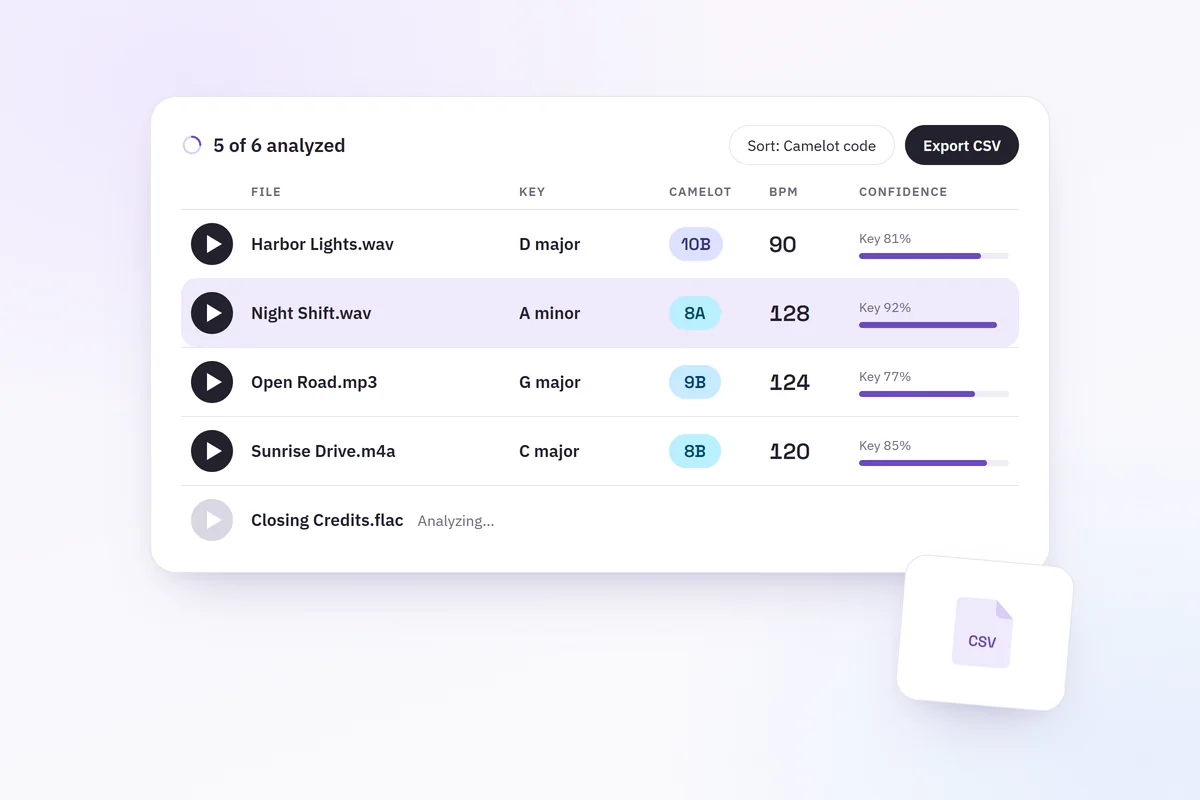
Drop in up to 50 files at once. They are read one after another on your device, and the results table fills in as each song finishes. Sort it by Camelot or BPM.

  • Up to 50 songs per batch, no upload
  • Sort by Camelot code, BPM or order added
  • Export every result as a CSV file
Batch results table listing the key, Camelot code and BPM of five songs, with one still analyzing and an Export CSV button
Your whole crate in one table
Camelot wheel with 8A selected and the compatible keys 9A, 7A and 8B lit up, next to a list of songs in key
Mix in key across your set
03 / HARMONIC MIXING

Find songs in key to mix

Select a track and the Camelot wheel lights up the keys that blend with it. The helper lists songs in key from your batch with their tempo gap, plus near misses.

  • Same key, one step and relative key shown
  • Matches from your own list with tempo gap
  • Near misses a semitone or two away
USE CASES

Who uses a BPM and key finder

Anyone who has to fit one piece of music to another. Six common jobs for key and BPM data.

Preparing a DJ set

Scan a new crate in one go, sort it by Camelot code and tempo, and see which tracks can follow each other without clashing notes.

Remixes and mashups

Check an acapella and an instrumental side by side. If their keys sit one step apart and the tempos are close, the blend needs little work.

Singers and cover bands

Get the key and tempo of every song on a setlist before rehearsal, then move any song that sits too high with the pitch changer.

Video and podcast editing

Pick background tracks that share a key and a similar tempo, so a cut from one music cue to the next sounds planned, not jarring.

Practice and lessons

Know the key and BPM before you learn a song: set the metronome to the tempo and warm up on the scale of the home key.

Workout playlists

Sort a running or class playlist by BPM, keep songs near your target tempo, and order them so the keys flow from track to track.

COMPARE

Which BPM and key finder fits the job?

This song key and BPM finder sits between one-song checkers and desktop DJ software. Here is how they differ.

CompareThis key BPM finderOne-song findersDesktop DJ software
Songs per runUp to 50, analyzed one after anotherOne file at a timeA whole library
What you needA browser, no install or sign-upA browser, file by fileAn installed app on a computer
Where audio goesStays on your device, never uploadedVaries by siteStays in your local library
Mixing helpCamelot wheel, matches, key shiftsUsually a key and a Camelot codeKey codes in the library view
ExportCSV with key, Camelot and BPMCopy one result at a timeSaved in the app's library
Best forChecking a new batch before a setA quick look at one songManaging a large DJ collection
ACCURACY TIPS

6 tips for better key and BPM results

Most odd readings come from the audio itself. Run through these checks when a key or tempo looks wrong.

  1. 01

    Read the confidence first

    Each row has its own key and beat confidence. A low score is flagged in the table and means the file gives the analysis little to go on.

  2. 02

    Check half and double time

    Tempo can be counted on every beat or every other one. If 87 BPM feels slow, the 174 reading is the same song counted twice as fast.

  3. 03

    Mind the relative key

    A minor and C major share the same notes, so a reading can land on either one. For mixing it matters less: 8A and 8B blend either way.

  4. 04

    Analyze single tracks

    A DJ mix or medley holds several keys and tempos and gets one blended answer. Split it into songs; only the first 10 minutes are read.

  5. 05

    Tap when the beat drifts

    Live takes and rubato pieces drift. Tap along on the tap tempo button while the track plays and use your tapped BPM for that row.

  6. 06

    Use the cleanest file

    A full-quality file beats a phone recording of speakers. Room noise, crowd sound and heavy distortion blur both the notes and the beat.

FAQ

BPM and key finder FAQ

Answers about finding the key and BPM of songs, Camelot codes and how this tool works.

How do I find the key and BPM of a song?+

Drop the song into the BPM and key finder above. It reads the file in your browser and shows the key, such as A minor, its Camelot code and the BPM, each with a confidence score. Add more files and they are analyzed one after another.

Can I find key and BPM for many songs at once?+

Yes. Choose or drop up to 50 files in one go. They are analyzed one after another on your device and fill a results table you can sort by Camelot code or BPM, copy row by row, or export as a CSV file for a spreadsheet or your DJ notes.

Is a key and tempo finder the same as a BPM key finder?+

Yes. Tempo is the speed of a song and BPM, beats per minute, is how it is measured. So a key and tempo finder, a key BPM finder and keybpm tools all do the same job: name the key of a recording and count its beats per minute.

How accurate is this song key detector?+

It is most reliable on music with clear chords and a steady beat, such as pop, dance and hip-hop. Every row shows separate key and beat confidence, and low scores are flagged. When a result feels off, check the relative key and the half-time reading.

What do the Camelot codes and the wheel show?+

The Camelot wheel numbers the 24 keys from 1 to 12, with A for minor and B for major. Select a track and the wheel lights up the keys that mix with it: the same code, one number up or down, and the same number with the other letter.

How do I find songs in key with my tracks?+

Analyze your tracks, then select one. The helper lists the songs in key from your batch with the tempo gap to each, plus songs one or two semitones away that you could move into key with the pitch changer before you mix them.

Does it detect the time signature too?+

No. It finds one key and one tempo per file but does not work out the time signature. To find it by ear, count along with the beat and listen for the strong first beat of each bar: most pop songs are in 4/4 and waltzes are in 3/4.

Is it free, and are my songs uploaded?+

It is free with no sign-up. Files are decoded and analyzed in your browser with signal processing, not AI, and never leave your device. It reads MP3, WAV, M4A, AAC, OGG and usually FLAC, up to 100 MB each and the first 10 minutes of a file.
FIND YOUR VOICE

Find the key and BPM of your next set

Drop your tracks into the tool above. It is free, needs no account and nothing leaves your device.

Try it with a file