Skip to content
VoiceFinch
All voice tools

Deep Voice TestSee how low you really speak

Read a short passage aloud for 10 to 20 seconds and this free deep voice test measures how deep your voice is: your median speaking pitch in Hz, the nearest note and a depth score from 0 to 100, from Very deep to Higher, compared with typical adult voices. No sign-up, and your voice is analyzed in your browser, never recorded or uploaded.

  • Depth score out of 100
  • Median Hz and nearest note
  • Free, nothing recorded
Deep voice testFree · no sign-up
Text to read
Read this out loud in your everyday voice
On Saturday mornings I walk to the market before it gets busy. I buy a loaf of warm bread, a bag of green apples and whatever flowers look brightest, then sit by the fountain for a while and watch the town wake up.
  • Use your everyday voice. Forcing it lower than usual gives a number you could never keep up in real conversation.
  • The sound is analyzed inside this browser tab. Nothing is recorded, saved or uploaded.
10–20 seconds of reading
How it works

Taking the deep voice test in three steps

Around fifteen seconds of normal talking is enough. Find a quiet spot and keep the mic about an arm’s length away.

  1. 01

    Pick a passage, then allow the microphone

    Choose any of the three short texts, press Start recording and accept the mic prompt. The passages stick to ordinary vocabulary, which makes it easy to read them in your natural voice.

  2. 02

    Read in your normal voice

    Keep your usual pace and volume. Don’t press your voice down: the score is meant to describe the voice people hear from you every day, not your lowest rumble. Recording ends on its own after 20 seconds.

  3. 03

    See your depth score

    The result gives your score out of 100 and its label, your median in Hz alongside the closest note, and a bracket on the scale showing your typical range. Save the card, copy the figures or go again.

Quick reference

How deep is your voice? Hz, notes and scores

Your score depends only on your median speaking pitch. Look up a median in the first column to see its note, score and label.

Median pitchNearest noteDepth scoreLabel
80 HzD#295Very deep
90 HzF#285Very deep
100 HzG276Deep
110 HzA269Deep
120 HzB262Deep
140 HzC#349Average
160 HzD#338Average
185 HzF#326Higher
210 HzG#316Higher
240 HzB35Higher

The score sits on a log scale, the way hearing works: 100 at 75 Hz and 0 at 255 Hz, so every 10 points is a step of roughly two semitones. Labels: Very deep below 95 Hz, Deep from 95 to 125 Hz, Average from 125 to 185 Hz, Higher from 185 Hz. One scale is used for everyone, with no adjustment for sex or age, so most women and children land in Higher. For context, most adult men talk between roughly 85 and 180 Hz and most adult women between roughly 165 and 255 Hz.

What you get

Why a deep voice test needs a whole passage

Anyone can drop their voice for one word. Measuring a full passage shows the pitch you settle into when you are simply talking.

  • Very deep
  • Deep
  • Average
  • Higher

Your median, not your lowest word

The test checks your pitch about 40 times a second and keeps the median of all those readings, so a single booming word or a nervous laugh hardly moves it. The outlined bracket marks your typical range, where the central 80% of your readings fall.

Depth score
76/100
Median
100 Hz
Nearest note
G2
Variation
2.4 st

A number that is easy to share

A score between 0 and 100 is simpler to remember than a frequency. It follows a log scale, as hearing does, so the same gap in points means the same audible difference whether you start deep or high.

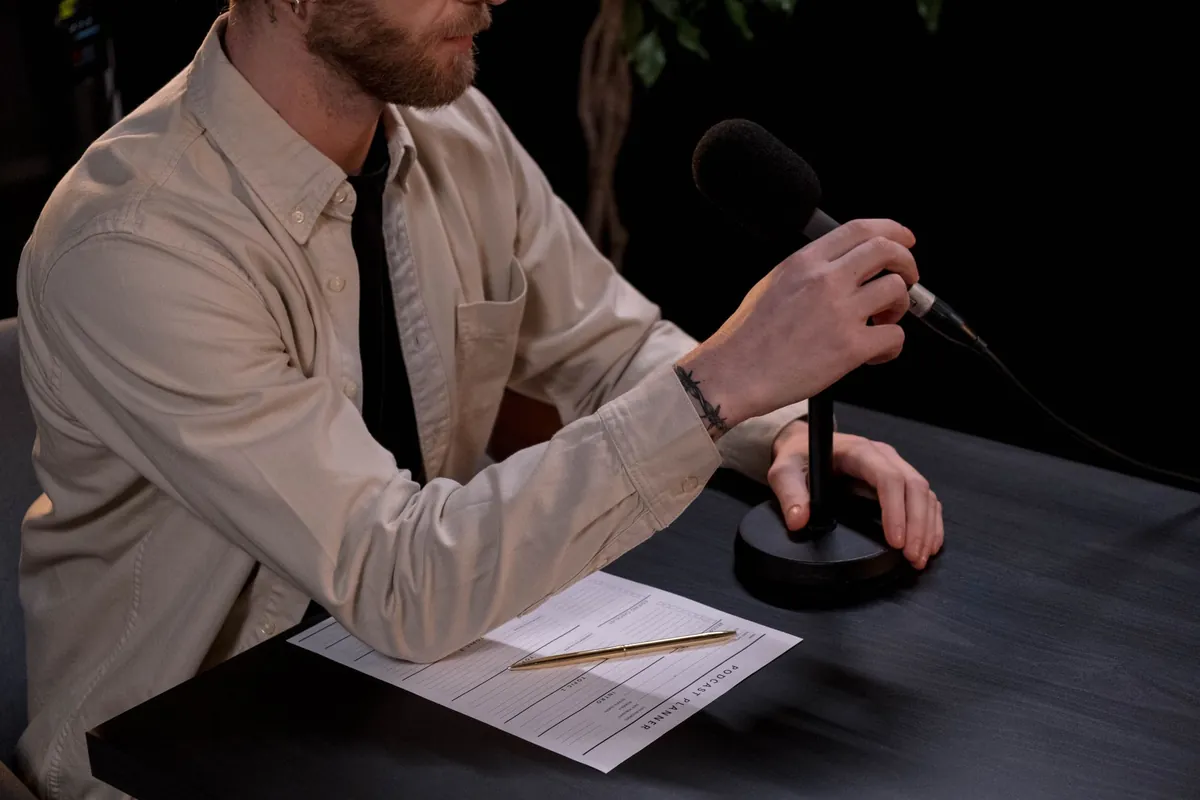
Man speaking into a desk microphone with notes in front of him

Useful for tracking change

If you are building a lower, fuller speaking voice, test under the same conditions each time: same passage, same mic, a similar hour. Ignore single results and watch the median over a month; that trend says far more than any one day.

Stays on your device

Pitch tracking runs inside your browser. No recording is kept, nothing is uploaded and there is nothing to sign up for. The shareable image is created on your own device, and only if you press Save.

What makes a voice deep

How deep is my voice, and where does depth come from?

A voice sounds deep mainly because of its pitch: how many times a second your vocal folds vibrate. Larger, heavier folds cycle more slowly. During puberty the larynx grows considerably in most boys and their vocal folds lengthen, which is why adult men usually speak about an octave below adult women. A median of 100 Hz means your folds open and close about 100 times every second.

Pitch is only half of what people mean by a deep voice. The spaces above your vocal folds, your throat, mouth and nose, filter the sound into resonance. A relaxed throat and easy breath support can make the very same pitch sound darker and rounder. The score here is built from pitch alone, so read it as one ingredient of a deep voice, not the whole recipe.

Vocal fold size. Folds that are longer and thicker cycle more slowly, producing a lower pitch. This is largely set by puberty and hormones, and it is what the score measures.

The space above the folds. A longer throat and a roomier mouth darken the tone. Many people with deep-sounding voices have strong low resonance rather than an unusually low pitch.

Breath and effort. Pushing air hard tends to raise pitch. A voice that rides on easy, steady breath usually settles lower without any forcing.

Tempo and melody. Unhurried speech, real pauses and phrases that come to rest at the bottom read as low and grounded, even when the Hz barely changes.

A fair reading

Getting a deep voice test result you can trust

The most common mistake is performing. Forcing your voice down to its floor for twenty seconds produces a score you can’t hold in conversation, and it often tips into vocal fry, the creaky rattle at the very bottom of a voice. Fry has no steady pitch, so the detector skips most of it, which means a forced reading tends to be less reliable rather than deeper.

Read the passage as if you were chatting with a colleague across a desk. Test somewhere quiet, sit or stand comfortably and keep the same distance from the mic each time. If you plan to compare results over weeks, stick to one passage and a similar time of day, since many voices sit lower in the morning.

If you would like a lower speaking voice, the guide on how to make your voice deeper covers safe, practical work on breath, resonance and pacing. Go gently: if your throat feels tight or sore, or hoarseness lasts more than a couple of weeks, stop and check in with a doctor or a voice teacher. Just for fun, the deep voice changer lets you hear yourself several notes lower right away, and the voice Hz test shows the same median next to typical men’s, women’s and children’s ranges.

Last updated November 6, 2026
Who it's for

Why people take a deep voice test

People take it for fun, for work and for practice. These are the most common reasons.

Hosts, streamers and narrators

Check the pitch of your on-air voice against your relaxed off-mic voice. A big gap between the two usually means you are pushing.

Voice actors

Measure your natural pitch first, then build lower character voices that you can hold through a long session.

Anyone in voice training

Record your median every couple of weeks during breath and resonance practice or gender-affirming voice work.

Group challenges

Each person reads the same text and you compare scores. Great for a group chat, as long as everyone remembers that every pitch is a perfectly good voice.

FAQ

Deep voice test FAQ

What your score means, what counts as deep and how to get an honest reading.

Still curious?

Your own score answers most of these. It takes about fifteen seconds of reading.

How deep is my voice?

Read a passage for 10 to 20 seconds and you get a 0–100 depth score plus your median speaking pitch. The labels split at 95, 125 and 185 Hz: under 95 Hz is Very deep, then come Deep and Average, and from 185 Hz up the label is Higher.

What Hz counts as a deep voice?

For an adult man, a speaking median under roughly 100 Hz is generally heard as deep, and under about 90 Hz as very deep. For an adult woman, a median under about 170 Hz already sounds low and full. Resonance matters too, so the same Hz can sound deeper in one person than in another.

What counts as a deep voice for a woman?

The score uses one scale for everyone, so most women land in Higher. Compare your median with typical women’s voices instead: most speak between about 165 and 255 Hz, so a median around 165–180 Hz is on the deep side for a woman. The male or female voice test shows this on a scale of typical ranges.

Is this deep voice test accurate?

The pitch measurement itself is accurate to within a hertz or two on clear speech. The bigger variables are you and your setup: how you read, how loudly, background noise and the time of day. Test two or three times and go with the result that repeats.

Why did I score lower than I expected?

A lower score means a higher median. Reading aloud often lifts pitch, especially when you are concentrating, a bit nervous or projecting for the mic. Try reading more slowly and quietly, as if talking to one person across a table, then test again.

Is it possible to lower my speaking voice?

Your pitch is mostly set by anatomy, but you can usually lower your everyday speaking pitch a little and make it sound fuller with relaxed breathing, resonance work and calmer pacing. The guide on how to make your voice deeper has safe exercises. Never force your voice down, and see a doctor if hoarseness lasts.

Is a deeper voice better?

No. Lower voices are often described as calm or authoritative, but warmth, clarity and expression shape how you come across just as much. The score describes where your voice sits; it is not a grade.

Does the deep voice test keep my recording?

No. The audio is analyzed in your browser while you read and is never stored or sent anywhere. Any result image is generated on your device, and only when you ask for it.

Get your depth score

Read one passage in your natural voice, and your score appears within about fifteen seconds, with your median in hertz. Nothing to install, and the audio never leaves your device.