
Soprano signs
Phrases around E5 to G5 feel bright and easy, the notes below A3 get quiet or breathy, and your voice moves into head voice late, near F#5. Holding the tune over a full choir feels natural.
A soprano usually sings from C4 to C6 (262 to 1,047 Hz) and an alto from F3 to F5 (175 to 698 Hz); they overlap from middle C to F5, and in a choir the soprano usually carries the melody while the alto sings the harmony below. Sing into the free mic test below to see whether you match soprano, alto or the mezzo-soprano in between, with your range in notes and Hz, no sign-up and nothing recorded.
Begin on a low, relaxed “ah”, somewhere you could hum all day.
Climb one step at a time, or glide slowly, resting about 2 seconds on each note.
Press Stop when the next note would be a strain. Squeaks and cracks are left out.
Tap a key to hear its note
The alto reference range sits seven semitones below the soprano, a perfect fifth. Between middle C and F5 the two share 18 notes, so the comfortable middle, the gear changes and the tone tell you more than the extremes.
| Feature | Soprano | Alto |
|---|---|---|
| Reference range | C4 – C6 | F3 – F5 |
| Frequency | 262 – 1,047 Hz | 175 – 698 Hz |
| Comfortable middle | About F4 – G5 | About A3 – C5 |
| Lower gear change | Around E4 | Around G4 – Ab4 |
| Upper gear change | Around F#5 | Around D5 |
| Tone | Clear and bright, floats on top | Rich and dusky, strongest in the low middle |
| Choir job | Usually the melody, the top line | Harmony just below the melody |
| Solo roles | Violetta (La traviata), Gilda (Rigoletto), Maria (West Side Story) | Orfeo (Gluck), Mistress Quickly (Falstaff), the alto solos in Bach's St Matthew Passion |
Alto is strictly a choir part; the solo voice type with this range is contralto, and this site uses “alto” for that F3 to F5 range. Many choir altos are in fact mezzo-sopranos, the voice type in between. Notes use scientific pitch notation, with C4 as middle C.
Both voices on one note axis. The shaded column is the shared stretch, the strip under each bar marks the comfortable middle, and the flag marks the upper gear change into head voice.


The shared stretch covers most choir writing for women, which is why many singers can switch parts. Mezzo-soprano, A3 to A5, sits right across the middle of this chart.
No piano or teacher needed for a first answer: the test gives you the numbers, and two short listening checks tell you how to read them.
Warm up for two minutes, press Start and climb from a comfortable low note to your highest clean one, holding each until the ring fills. On the result, set Compare as to Female to see your soprano, mezzo-soprano and alto scores side by side.
Your floor changes less with training than your top. A clear, steady F3 or G3 points to alto. If your voice turns to a whisper somewhere between A3 and C4, soprano or mezzo is more likely.
Slide slowly up from A4 on “oo” and notice where the voice wants to lighten or flip into head voice. Around C#5 to D5 points to alto; staying even until about F5, then shifting near F#5, points to soprano.
Range overlaps, so these clues help. Two or three of them pointing the same way is a fairly safe answer.
Phrases around E5 to G5 feel bright and easy, the notes below A3 get quiet or breathy, and your voice moves into head voice late, near F#5. Holding the tune over a full choir feels natural.

Your voice sounds warm and full from G3 to C5, chest voice reaches up to about G4 without pushing, and long stretches above D5 wear you out. Harmony lines come easily, even next to a strong melody.
If both lines feel fine, you may be a mezzo-soprano, the most common female voice. The example A3 to G5 scores 92% mezzo, 84% alto and 80% soprano. Our mezzo-soprano vs alto guide covers that case.
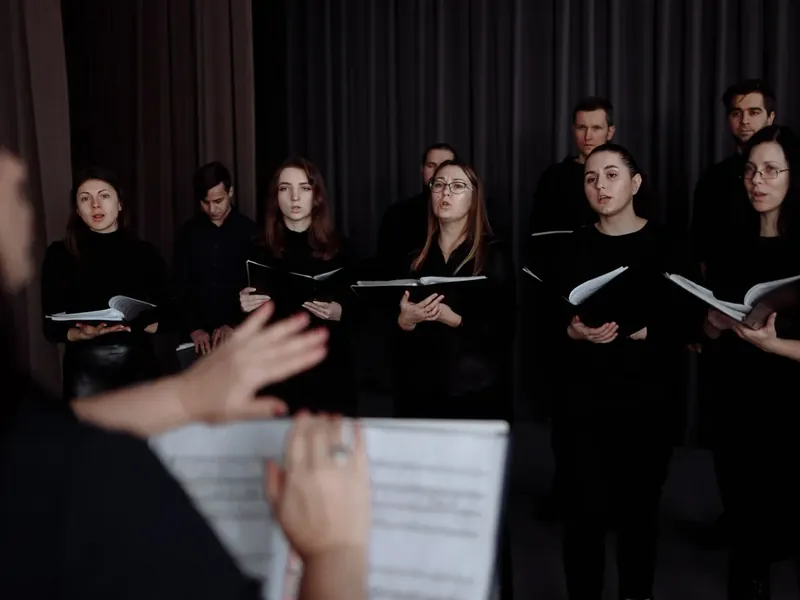
SATB is the standard four-part mixed choir. Each choir line uses only the middle of its voice type's full solo range, which is why so many voices can sing more than one part.
| Part | Solo voice range | Usual choir line | Job in the harmony |
|---|---|---|---|
| Soprano | C4 – C6 | C4 – G5, rarely A5 | The tune, on top |
| Alto | F3 – F5 | G3 – C5, sometimes D5 | Inner harmony under the tune |
| Tenor | C3 – C5 | C3 – G4, sometimes A4 | Upper men's line, often the counter-melody |
| Bass | E2 – E4 | F2 – C4, sometimes D4 | The foundation, usually the chord roots |
Tenor parts are written in treble clef an octave above where they sound. Mezzo-sopranos and baritones have no line of their own in SATB, so they join whichever part suits them. Exact limits vary with the piece and the arranger. For the men's side of the choir, see tenor vs baritone and baritone vs bass.
The soprano and alto bars overlap far more than the alto and tenor bars do, which is why the women's parts trade singers so often.
See every voice type, including mezzo-soprano, countertenor and baritone, on the vocal range chart.
The placement check. Most choir directors place new singers with a short hearing: a scale up and down, a high phrase, a low phrase, sometimes a line of a familiar song. They listen for range, but also for color and for how well you hold a harmony line while someone else sings the tune.
Balance plays a part. A choir with thirty sopranos and eight altos will ask its mezzos to sing alto, and the reverse happens too. So your choir part and your voice type are not always the same thing. Many mezzo-sopranos spend years on the alto line and do it well.
A part should not hurt. The right line feels tiring only at its extremes. If your part leaves your throat tight after most rehearsals, ask to try the other one for a few weeks, and retest with the vocal range test to see whether your comfortable notes moved.
Teens should expect changes. Girls' voices deepen by a few semitones and gain color through the teenage years, so a 13-year-old soprano can be a comfortable alto at 18. The opposite happens as well, once head voice develops and the top gets easier.
Sopranos: build the middle. The lower half of a soprano voice can sound thin next to altos and men. Gentle descending slides on a hum from A4 to A3, sung without pushing, fill it out over a few months.
Altos: free the top and guard the tuning. Altos need an easy head voice above D5 and steady pitch on inner notes, where it is easy to drift toward the melody. Sirens through D5 and practicing your line against a recording of the tune both help; the tone deaf test is a quick check on pitch matching.
Both: change gears quietly. The gear change from chest to head voice is where most strain starts. Our guide to chest voice vs head voice explains the two registers and how to blend them.
Last updated November 6, 2026Whichever side of the soprano vs alto line you land on, the same short routine pays off.
Warm up the whole range: five minutes of lip trills and sirens from your lowest easy note to your highest, before every rehearsal.
Learn your line alone: practice your part without the melody first, then with it. Record yourself and listen back for drift.
Borrow the other part now and then: sopranos who sing alto lines train their ear; altos who sing the tune loosen their top.
Don't force the edges: if your part sits too high or too low for weeks, talk to your director instead of straining. Hoarseness that lasts is worth a doctor's visit.
Quick answers about the two women's choir parts, the voices in between and the test on this page.
A minute of singing tells you more than a chart. Try the test at the top of the page.
Soprano is the higher female voice, about C4 to C6 (262 to 1,047 Hz), and usually sings the melody. Alto is the lower part, about F3 to F5 (175 to 698 Hz), and sings harmony beneath it. Sopranos sound brighter and feel best high in the staff; altos sound darker and feel best around middle C. Each voice has its own guide: soprano and alto.
Lean alto if F3 or G3 sound clear and steady and long phrases above D5 tire you. Lean soprano if your low notes fade below A3 and E5 to G5 feel easy. Sing the test above, set Compare as to Female, and compare the soprano, mezzo and alto scores.
As solo voice types: soprano C4 to C6, alto F3 to F5, tenor C3 to C5 and bass E2 to E4. Choir lines use less: roughly C4 to G5 for sopranos, G3 to C5 for altos, C3 to G4 for tenors and F2 to C4 for basses.
Yes. The alto range sits a perfect fifth, seven semitones, below the soprano. The two share the notes from middle C to F5, and the mezzo-soprano sits in between.
Often, yes. Most alto lines stay between G3 and C5, which many sopranos can reach, though the low notes may sound lighter than a true alto's. Singing alto is also good ear training. If the low notes feel pressed, go back to the soprano line.
Mezzo-soprano is usually described as the most common female voice, and true contraltos are rare. In choirs both sections are big because mezzos are spread across them, often as second sopranos or first altos.
Neither; it is its own voice type, about A3 to A5. In a choir a mezzo usually sings second soprano or alto, depending on where she is most comfortable and where the choir needs voices.
No. Your voice is analyzed inside this browser tab while you sing and then discarded. Nothing is recorded, saved or sent to a server, and you don't need an account.
Sing from your lowest steady note to your highest and see your soprano, mezzo and alto scores side by side. Free, no account, and nothing leaves your browser.