Female220 – 880 Hz

Mezzo-soprano
A3–A5Sits between soprano and alto with a fuller, warmer middle. Often said to be the voice most women have.
Sing into your microphone and this free online vocal range test shows your lowest and highest notes, in note names and Hz, plus your octave span and the closest of 7 voice types, in about a minute. It counts only notes you hold steady, so cracks and slides don’t stretch your range. No sign-up, nothing to install, and your voice is analyzed in your browser, never uploaded.
Begin on a low, relaxed “ah”, somewhere you could hum all day.
Climb one step at a time, or glide slowly, resting about 2 seconds on each note.
Press Stop when the next note would be a strain. Squeaks and cracks are left out.
Tap a key to hear its note
Four short steps, about a minute of singing and nothing to install. A built-in laptop mic, a phone or a headset all work.

Press Start and accept the mic prompt. The sound is analyzed on your device and never leaves the page.

Start on a relaxed low note and go up a step at a time, or slide up slowly like a siren. Guided mode works from the top down instead.

A note is counted once the ring fills, after about 2 seconds. Squeaks, cracks and quick slides are listed apart as brief extremes.

Press Stop to see your two steady notes in Hz, your octaves and how you compare with each voice type. Then look yourself up on the vocal range chart.
Stopping the test opens a full result screen. Using an example range of A2 to G4, this is how to read each part of it.
A2G4
110 – 392 Hz
The headline is the span between the bottom and top notes you managed to hold steadily, and each one comes with its frequency in hertz. Middle C is C4 (about 262 Hz) and the A above it is 440 Hz. A note you only touched for a moment goes into a separate brief extremes box, so one lucky squeak can’t inflate the result.
Keep an eye on your brief extremes. With warm-ups and practice, some of them often turn into comfortable notes.
A2–G4 · 22 semitones ÷ 12 = 1.8 octaves
Take the number of semitones from your bottom note to your top note and divide it by 12. A2 to G4 spans 22 semitones, which works out to 1.8 octaves. Adults without training often land between 1.5 and 2 octaves, trained singers commonly reach 2 to 3, and anything above 3 is unusual.
If your span looks small, the usual causes are a voice that hasn’t warmed up yet or notes that stopped before the ring was full. Hum for a few minutes and test again.
Closest match: Baritone
Seven classical reference ranges sit behind the bars, and each percentage shows how much of that range your notes cover. Filter to male or female types if you like, or choose Skip to keep all seven in the list.
Teachers also listen for tone color and for the notes where a voice feels most at ease, so read the top bar as a starting point.
A2G4
110 – 392 Hz
Save image draws your range, octaves and closest voice type onto a PNG you can keep in your practice notes or send to a choir director or singing teacher. Copy result gives you the same summary as a line of text.
Saving a new image after each test makes it easy to see your range grow over a few months.
Most adults without vocal training cover something like one and a half to two octaves. The width is similar for everyone; what differs is the position, with men’s voices starting roughly an octave lower than women’s. That position is the best first hint about your voice type, and the vocal range chart maps every type in detail.
When a man and a woman sing the same tune together, they are usually an octave apart without noticing. The bars show the standard classical reference ranges (C4 is middle C), which singers without training may not fill completely.
Knowing your notes is step one. Matching them to a voice type tells you which choir part to join, which song keys to pick and which singers are worth studying. These are the seven classical types, ordered from the highest voice to the lowest.
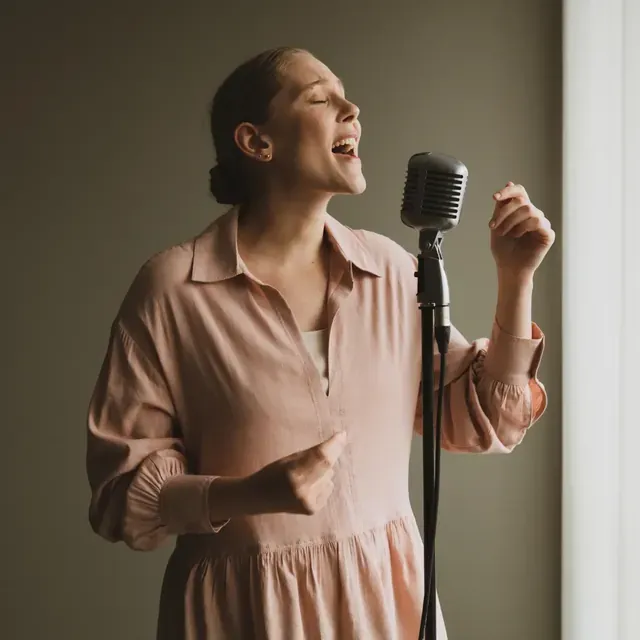
The highest voice type. Light and bright on top, and usually the voice carrying the tune in a choir.
Sits between soprano and alto with a fuller, warmer middle. Often said to be the voice most women have.

The lowest female voice, warm and dark. Choir altos hold the inner harmony, and true contraltos go lower still.

A male voice that sings in the alto range, mostly in head voice. Heard often in early music and choirs.

The highest common male voice, known for bright, ringing top notes in rock, pop and opera.

The most common male voice, between tenor and bass, with a warm middle that suits most pop songs.

The lowest voice type, with a deep, dark sound that holds up the harmony from below.
Sing for about a minute and see how your range overlaps all seven voice types.
Once you know your notes, these free tools help you choose and adjust songs that fit them, or hear your words in a completely different voice.
Upload a song to find its key, then check whether the melody fits between your lowest and highest notes.
Move a backing track up or down a few semitones so the song sits inside your range.
Take the vocals out of a track to make a karaoke backing you can sing over.
Write a short script and have it read aloud by a robot, Santa or a cartoon character, then download the audio.
Some online range checkers simply grab the most extreme pitch the microphone hears, even a crack or a whistle. This one only counts notes you can actually sustain, and the analysis happens on your own device.

Your pitch is checked about 40 times a second. A note is counted after it stays within half a semitone for 2 seconds, with vibrato smoothed out, so slides and cracks can't stretch your range.

The mic signal is analyzed in the browser tab and discarded as you go. No recording is made, nothing is uploaded and there is no account to create.

Detection covers C2 (65 Hz) to C6 (1,047 Hz), every classical voice type, and it filters out the sudden octave jumps that trip up simpler pitch trackers.
The keyboard in the test runs from C2 to C6, four octaves that hold every classical voice type. These are the landmarks worth knowing when you read your result.
| Note | Frequency | Where it sits |
|---|---|---|
| C2 | 65 Hz | Left end of the keyboard, below most bass voices |
| E2 | 82 Hz | Bottom of the bass reference range |
| A2 | 110 Hz | Bottom of the baritone reference range |
| C3 | 131 Hz | Bottom of the tenor reference range |
| F3 | 175 Hz | Bottom of the alto reference range |
| C4 | 262 Hz | Middle C, where the soprano range starts |
| A4 | 440 Hz | The tuning A, top of the baritone range |
| C5 | 523 Hz | Top of the tenor range, the tenor's high C |
| A5 | 880 Hz | Top of the mezzo-soprano range |
| C6 | 1,047 Hz | Top of the soprano range, the soprano's high C |
Frequencies use equal temperament with A4 at 440 Hz. Each octave doubles the frequency, and each semitone raises it by about 6 percent.
Knowing your range saves guesswork whenever you pick a part, a song or a key.
Find out whether soprano, alto, tenor or bass suits you before the next rehearsal or audition.
Know your top note before you choose a song, so the chorus doesn't catch you out halfway through.
Test every few weeks, save the image each time and watch your range widen as you practice.
Write melodies that sit inside your own range, or inside the range of the singer you are writing for.
Warm up first. Two or three minutes of humming, lip trills or gentle sirens loosen the voice. A cold voice often tests several notes short at both ends.
Use an open vowel. “Ah” or “oh” at the volume you would use to talk to a friend gives the clearest pitch. Whispering and shouting both make tracking harder.
Find a quiet spot. Background music is the most common cause of a jumpy trace, because the detector can follow the song instead of you. Fans and TV noise matter less, but switching them off still helps.
Stop at comfortable. The comfortable range is the number that helps when you choose songs and choir parts. If a note hurts or scratches, it isn't part of your range today.
Test on different days. Your range moves with sleep, hydration, time of day and practice, and morning voices often sit lower. Test a few times and keep the range you can repeat.
Last updated November 6, 2026Common questions about the test, the numbers it gives you and the things that affect your reading.
Sometimes the fastest way to understand the result is to see your own. Give the test a go.
No. You can run it as often as you like without an account or a download. It works in any current browser on a phone, tablet or computer, and the sound from your mic is processed on your device instead of being sent to a server.
Warm up for a couple of minutes, press Start and sing an open “ah”, beginning on an easy low note and climbing until the next note would strain. Pause on each note until the ring fills. Press Stop to get your range, octaves and voice type. No microphone? Choose Pick notes and find your notes by ear on the keyboard.
Your vocal range is the span of notes you can sing with control, and there is no single good number. Around 1.5 to 2 octaves is normal for adults without training, and 2 to 3 is common for trained singers. For choosing songs, where your notes sit matters more than how many there are.
Most adults sing about one and a half to two octaves comfortably. Steady practice often adds a few notes at each end, and well-trained singers frequently reach two to three octaves. Spans well beyond three octaves are rare and usually include special registers such as vocal fry or whistle tones.
Yes. It finds the lowest and highest notes you can hold and lines them up against the seven classical voice types, so it covers what people look for in a vocal range finder, a voice range test or a singing range checker.
On a clear, steady note the pitch is measured within a few cents, far finer than the half semitone the test needs. Your mic, background noise and how warmed up you are make a bigger difference. Because a note only counts after two steady seconds, the result reflects what you can actually sustain.
Whatever you have. The built-in mic on a laptop or phone is fine, and you don’t need headphones because the test is silent while you sing. In a noisy room, a headset mic close to your mouth helps.
It gives you a solid first estimate by ranking all seven voice types by how much of each range you cover. A teacher or choir director will also listen to your tone and to where your voice changes register before settling on a label. You can read more about the soprano voice type.
Voices react to sleep, hydration, colds, the time of day and how much you have already used them. Early in the morning your low notes often come easily while the top is shorter. Test at a few different times and treat the range you can repeat as yours.
Usually, a few notes at a time. Daily warm-ups, slides through the places where your voice changes register and gentle work near your top and bottom notes all help, as long as you never force it. The tone deaf test is a handy way to check your pitch accuracy while you train.
Warm up, press Start and sing. You’ll get your notes, your octave span and a voice type match, with nothing to install.