
Settling a family debate
Someone at home insists they are tone deaf? Two minutes with headphones usually ends the argument, and usually in their favor.
This free tone deafness test plays 20 rounds of note pairs, and you say whether the second note is higher, lower or the same. The steps shrink as you answer correctly, so in about two minutes you see the smallest pitch change you can hear, down to 10 cents. It is a pitch discrimination test, not a medical diagnosis of amusia. Headphones help; no mic and no sign-up needed.
20 rounds, two notes each. Your job is to say whether the second note was higher, lower or the same as the first. It starts easy, with a full semitone (100 cents) between them, and the gap narrows each time you answer correctly.
Headphones give the cleanest result. iPhone users: set the ring/silent switch to ring, or you will hear nothing.
It is twenty short rounds of listening. A quiet room and a pair of headphones give you the most accurate number.

Before round one, press Play a test sound. If the notes sound thin or distant, turn the volume up or plug in headphones: later rounds use changes as small as a tenth of a semitone. Only your speakers are used; the microphone is never switched on.
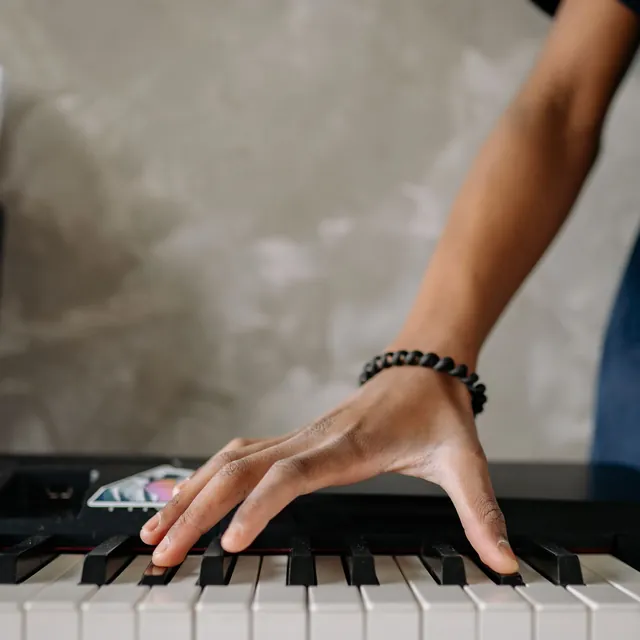
Listen to the pair, then choose Higher, Lower or Same (keyboard: ↑, ↓, S). The difficulty follows you: a correct answer makes the next change smaller and a wrong one makes it larger, so every round stays near the edge of what you can hear.
Your result leads with one number: the smallest change your ears caught consistently. Next to it are your score out of 20, how you did on the matching pairs, and what the number means in plain words.
Your score is a distance in cents between two notes: the smallest one you could still hear. Think of it like golf, where lower wins. For scale, two neighboring piano keys sit 100 cents apart.
Where each result level sits
cents, smaller is finer
| Level | Your number | Share of a semitone | In plain words |
|---|---|---|---|
| Fine-tuned ear | 20 cents or less | 0.20 or less | Musician-level detail |
| Clearly not tone deaf | 21 to 45 cents | 0.21 to 0.45 | Finer than most people without training |
| Typical pitch hearing | 46 to 90 cents | 0.46 to 0.90 | A normal result for untrained ears |
| Worth a retest | 91 to 150 cents | 0.91 to 1.50 | Try again with headphones in a quiet room |
| Possible pitch difficulty | Over 150 cents | Over 1.50 | Retest on another day, then read about amusia below |
These bands are a practical guide for this particular test, not medical categories. Scores vary from run to run, so the average of two or three attempts tells you more than any single one.
A fixed quiz spends most of its questions on changes that are far too easy or far too hard for you. An adaptive pitch discrimination test keeps moving the difficulty to the edge of what you can hear, which is where the useful information is.
Gap in cents, log scale
Rounds with a change
Get a round right and the next change is smaller; miss one and it grows. Early on the steps drop quickly, then they settle into small moves around your limit. That zig-zag is called a staircase, and your score is worked out from the gaps where the line changes direction.
The dashed line is the score this example run would get.
Correct: the two notes matched.
Somewhere in your twenty rounds, four pairs are exactly the same note played twice. A careful listener answers Same; someone guessing tends to hear movement that is not there. Two or more misses on these pairs put a note on your result so you know to retest.
If every pair began on the same note, you could memorize that note and judge only the second one. So the first note is drawn at random between A3 and A4 (220 to 440 Hz) every round, often landing between piano keys. The only strategy left is the one being measured: comparing the two notes you just heard.
You reliably heard changes well under half a semitone.
You get a number in cents rather than a verdict, which makes progress visible: practice for a month, test again and compare. The tones are built by your browser on the spot, so there is nothing to download, upload or record.
The everyday version. "I'm tone deaf" is usually shorthand for "please don't ask me to sing at the party." It describes a voice that wanders, not ears that fail, and in most cases the ears turn out to be fine.
The research version. Scientists reserve the term for congenital amusia, a condition present from birth in which the brain handles pitch poorly even though hearing tests come back normal. Someone with amusia may hear two notes a semitone apart and be unsure which was higher, may not notice a sour note in a song they know well, and may only recognize a tune once the lyrics start. Speech and everyday hearing are usually unaffected.
How many people have it. Studies place congenital amusia at somewhere between about 1.5 and 4 percent of the population. Far more people believe they have it: in surveys of students, self-described tone deafness has turned up several times more often than the real thing, and most of those people tested normally.
How it is confirmed. In a lab, amusia is assessed with a long series of melody, rhythm and memory tasks such as the Montreal Battery of Evaluation of Amusia. A two-minute amusia test online, this one included, is a screening tool: a strong score rules out a pitch problem for practical purposes, while a weak one is a reason to retest, not a diagnosis.
If it appears suddenly. When music starts to sound wrong after a stroke, a head injury or an illness, doctors call it acquired amusia. That needs a medical assessment rather than a web tool.
Last updated November 6, 2026Singing in tune is a loop: hear the target, move your voice, hear the result, adjust. A tone deaf test checks only the first step. Most people who sing off key do fine on it; the slip happens in steering the voice, and that is learned control. Think of handwriting: you could read neat letters long before you could write them, and the writing came with practice, not with better eyes.
If you scored well here, your ears are not what holds your singing back. Short, regular practice helps most: hold a single note from a keyboard app and sing along until the sound smooths out, sing short familiar phrases slowly at a comfortable pitch, and keep sessions to five or ten minutes a day. A phone recording will reveal drift you do not notice while singing.
Know your comfortable notes. Plenty of people sound out of tune only because a song sits too high or too low for them. The free vocal range test shows your lowest and highest steady notes, and the vocal range chart shows where they fall among the voice types. A key finder tells you what key a song is in, and the pitch changer can move it somewhere easier to sing.
If you scored in the last band, retest on a different day with headphones before drawing any conclusions. Even people with true amusia can enjoy music and sing for fun; it simply helps to know where the difficulty lies.
People come to it for all kinds of reasons, from settling a family argument to checking their ears before a choir audition.
Someone at home insists they are tone deaf? Two minutes with headphones usually ends the argument, and usually in their favor.
Know where your ear stands before the first rehearsal, so practice can go into your voice instead of worrying about your hearing.
A whole class can take it on school laptops with headphones and compare scores without anyone having to sing out loud.
Check how fine a detune you notice before you trust your ear on a vocal edit, a tuning job or a mix.
The questions people ask most after taking the test, answered briefly.
Two minutes of listening will tell you more than any article. Grab your headphones and try it.
The odds say no. Only a few people in every hundred are truly tone deaf, while many more simply have not trained their singing voice. The quickest way to know is the test above: if you can follow which way the notes move at one semitone or smaller, your pitch hearing is working.
It is a good screening check, not a diagnosis. The adaptive steps and same-note rounds make guessing easy to spot, but speakers, room noise and tiredness all move the score. Use headphones, pick a quiet room, and if a result surprises you, take it again on another day.
Because singing takes more than hearing. Your ear can notice a wrong note before your voice has learned to land on the right one. That gap closes with practice, especially matching single notes and listening back to recordings of yourself.
Yes. There is no sign-up, no payment and no limit on retakes. The notes are generated by your browser, so nothing is recorded or uploaded.
A clinical amusia test is a long battery of listening tasks given by researchers, covering melody, rhythm and memory. Many online quizzes just ask how you feel about music. This test sits in between: it measures one core skill, hearing which way the pitch moved, with an adaptive method in about two minutes.
Congenital amusia is lifelong and there is no proven cure, although some studies report modest gains from training. Off-key singing in people with normal pitch hearing is a different story: it usually improves a lot with regular practice.
It happens to almost everyone now and then. When you expect a change, your brain tends to supply one, and the second of two identical notes can seem slightly higher or brighter. One slip on the four matching pairs is normal; two or more usually means guessing.
A cent is one hundredth of a semitone, and a semitone is the gap from one piano key to the next, black or white. So 50 cents is half a semitone, and a 10-cent change is a tiny shift that only careful listeners pick up.
No. It is a listening test only. All you need is sound output, ideally headphones.
Grab your headphones and give it two minutes. You will leave with a real measurement of your pitch hearing instead of a guess.